Mad skills #
Mastery of hard-earned skills has largely been displaced by "hacks" and a focus on daily productivity in our modern world. Even with the rise of the 10-year / 10,000-hour research in the 2000s (Outliers came out in 2008!)1, we’re increasingly focused on the short term.
I recently went to a huge AI conference that spent a ton of time on how to introduce AI to your enterprise, but literally no one talked about skill development, learning, or teaching. Isn’t that odd?
And of course US companies spend roughly $98 billion a year2 on corporate training, yet only about a quarter of employees say it actually improved their performance3. The material isn’t usually to blame — it’s the method of learning.
You could write a whole book about what AI does to your other skills, but developing skills is what matters here. AI doesn’t have to be a scary magic box you never want to open.
Core elements of learning #
This is the section to link to/bookmark.
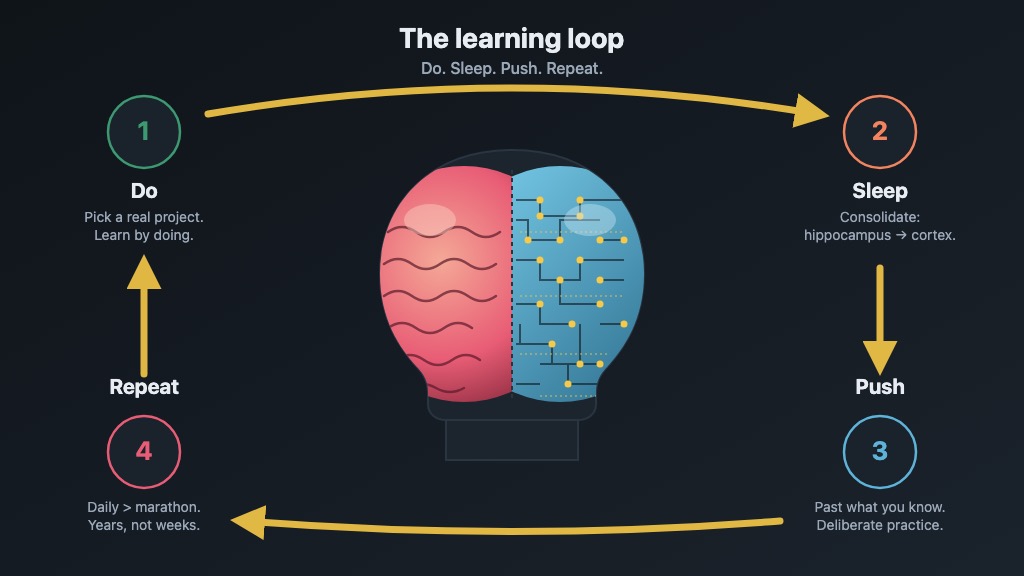
- Pick a project or task that has substance, but isn’t too complex or important
- And make the focus of your learning/skill development doing rather than just reading or watching
- Daily practice is far more effective than large sessions once a week — short, spaced repetitions stick4. With Claude or Codex, much of this can be done on your phone at any time
- Sleep is required to form memory and skill:
- Your hippocampus consolidates short-term memories into long-term storage in the neocortex while you sleep5
- This sets a practical ceiling on how much you can learn in a day, which is why daily practice matters so much6
- It’s also a good reminder to get those 7+ hours each night — waking up early to learn new things by cutting sleep literally works against you7
- Attention is the other half of memory:8
- If your day is 12 hours of stressful meetings, 30 minutes squeezed in between probably won’t cut it
- Carve out time where you can fully engage — after your normal work but before you’re too tired works well for most
- Deliberate practice — a complex subject, but the gist:9
- Doing more of what you already know doesn’t help — you plateau
- Push the boundaries of what you currently know/can do
- Is AI reading your email and calendar? Next week maybe it can proactively suggest schedule adjustments to give you more free time
- AI changes so fast that simply trying the new things every week or two keeps you learning
- Reading about AI adds more value as your skill grows (primarily from doing!)
- Try, don’t peek: actively try to do the thing — write the prompt, build the flow — before looking up someone else’s version. Recalling beats re-reading10
- Find something fun: if "learning AI" feels like more work, switch to something playful (ideas below). AI offloading busy work should feel great — but you have to get there first
- The process takes time: roughly 10 years minimum to master a complex subject1
- So just keep going!
Pitfalls to avoid #
- Large language models (LLMs) are stochastic (probabilistic / non-deterministic) systems — their outputs and actions vary run-to-run11
- This matters because deliberate practice depends on fast, accurate feedback — and stochastic outputs degrade exactly that signal
- Less of an issue as models improve, but still worth keeping in mind
- For example, if you’re trying to get a model to use just the right number of bullets vs. prose, the wording that worked once may be random chance rather than a truly effective prompt/solution
- If you get stuck: AI is increasingly good at fixing itself, but you may need to find the right way to describe the issue
AI project ideas #
- Research: huge one for most people. Tools like Claude have a research mode that searches the web, finds sources, synthesizes them, and produces a report
- Great for product/home/car/appliance purchases
- Local activities/restaurants/stores
- Initial planning and diligence for products/businesses/job search/random ideas
- Build an app or website: very easy these days
- FlutterFlow, v0, Lovable, Base44, Replit, etc.
- Arts, crafts, meals, fun stuff: endless
- I recently started using Claude Code to generate fun day-off plans for my older son
- Many people use AI to manage the family’s meals and shopping lists
Footnotes #
- Ericsson’s 10-year rule — top performers across domains have accumulated about a decade of deliberate practice. Gladwell’s Outliers (2008) popularized this as "10,000 hours," but Ericsson called that framing wrong: 10,000 hrs was the average by age 20, when the violinists studied "were nowhere near masters." ↩
- Training Magazine, 2024 Training Industry Report. U.S. training expenditures totaled ~$98B in 2024. ↩
- McKinsey research summarized in Why Most Corporate Training Programs Fail — only ~25% of employees say training measurably improved their performance, and only ~12% apply new skills back on the job. ↩
- Wikipedia, Spacing effect. Learning spread over multiple sessions produces more durable memory than the same total time massed into one session — Ebbinghaus’s original finding, replicated across a century of studies. ↩
- Wikipedia, Memory consolidation — Systems consolidation. The hippocampus stores memories temporarily (synapses change quickly); repeated reactivation gradually shifts them to the neocortex for long-term storage (slow-changing synapses). ↩
- Wikipedia, Sleep and memory. Slow-wave sleep consolidates declarative memory via hippocampal replay synced with neocortical spindles; REM consolidates procedural memory. ↩
- Wikipedia, Sleep deprivation — Cognitive and neurobehavioral effects. Sleep deprivation disrupts hippocampal long-term potentiation and the acquisition of new information; chronically sleep-deprived people also tend to underestimate their own impairment. ↩
- Wikipedia, Encoding (memory) — Depth of processing. Deeper-level processing requires more attention and engages more cognitive systems to encode information. ↩
- Ericsson, Krampe, & Tesch-Römer (1993), "The Role of Deliberate Practice in the Acquisition of Expert Performance," Psychological Review. See also Wikipedia, Practice (learning method) — Deliberate practice. Deliberate practice = focused, beyond comfort zone, immediate feedback — not repetition of what you already know. ↩
- Wikipedia, Testing effect. Active retrieval produces more durable learning than passive re-reading. ↩
- Wikipedia, Stochastic parrot. LLMs sample tokens probabilistically; same prompt, different runs, different outputs. ↩